
 1 hour ago
The federal environment minister, Murray Watt, has pledged to put an extra half a million square kilometres of Australia’s ocean out of reach of fishers and drillers in a step conservationists hope will “right the wrongs” of an Abbott-era downgrade of marine protection.
Watt confirmed last year Australia would put 30% of its ocean estate under a high level of protection that bans extractive industries as part of an international agreement to protect 30% of the planet’s oceans.
On Tuesday, Watt met conservationists, fishers and representatives from tourism, oil and gas and offshore wind to kickstart a review of management plans across 44 national marine parks.
Watt told Guardian Australia the process was a “major priority for our government this term” and said he wanted to avoid the “culture wars” ignited by the Abbott government before marine park maps were redrawn in 2018.
In a deeply contentious and controversial move, the Abbott government blocked Labor’s marine park plans in 2013 and called for a review. The Turnbull government followed through and downgraded planned protections across more than 1m sq km, keeping those areas open for fishing and drilling.
Watt said it was an example of the Coalition at the time “trying to create culture wars around environmental issues”.
Sign up to get climate and environment editor Adam Morton’s Clear Air column as a free newsletter
The minister said he believed it was possible to increase the area of marine sanctuaries – where extractive activities like fishing and drilling are banned – while protecting the environment and economic interests.
Currently, 24% of Australia’s ocean estate is highly protected – which is 2.2m sq km.
Watt said the extra 523,980 sq km that would be needed to hit a 30% target could come both by expanding areas within existing marine parks and by adding new areas.
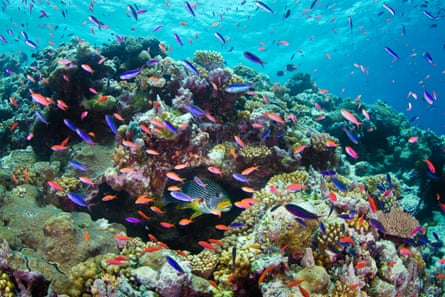
In 2018, the Coalition downgraded protections after a review of the previous Labor government’s plans, which were never put into force.
Richard Leck, the head of oceans at WWF Australia, said: “This is the Albanese government’s opportunity to right that wrong.”
A majority of the area downgraded in 2018 sat in the vast Coral Sea marine park to the east of the Great Barrier Reef which Leck described as the “Serengeti of the ocean”.
One study found that decision was, at the time, “the largest downgrade to a single (marine or terrestrial) protected area in history worldwide”.
“It was a big blow for marine protection in Australia and we are desperate to see that rectified,” Leck said.
“It is heartening to see the Australian government committed to protect 30% of our ocean by 2030. But this is where the rubber hits the road. We’re looking for a very strong outcome from this process.”
Marine parks undergo a statutory review every 10 years, and Watt said the first parks to be reviewed would be the Coral Sea and the eight parks of the Temperate East network, which include Norfolk Island and Lord Howe Island.
He hoped management plans could be completed in those areas by the end of 2027, with the rest needing to be complete by June 2028.
Fiona Maxwell, the national oceans campaign manager at the Pew Charitable Trusts, said: “This review is incredibly important. We only get one chance every 10 years to look at the level of protections.
“But it’s not just hitting a target. We need to make sure a full range of habitats are protected in the face of climate change.” Canyons, sea mounts and rocky reefs around Australia were in particular underprotected, she said.
Prof Jessica Meeuwig, the director of the Marine Futures Lab at the University of Western Australia, said: “If you look at the networks of marine parks around the continent, there’s only about 9% in highly protected areas.
“There’s a tremendous opportunity here to ensure this network is comprehensive, adequate and representative.”